
A child learns to say hola to a new friend. A few days later, the child recognizes a Spanish word in a picture book. Soon, a conversation about that book leads to a question about a family’s food, music, or traditions. Each moment is small, but together they make language feel useful and other people’s experiences worth understanding.
Spanish language and cultural learning can help children in Irvine practice communication, connect with neighbors, appreciate different family histories, and become more comfortable learning something unfamiliar. Children do not need to become fluent for those early experiences to matter. The most useful starting point is often a real conversation, a shared story, or a game they want to play again.
At SELF4Kids, our S.E.L.F. philosophy stands for Skills, Endurance, Leadership, and Flexibility. Language learning gives families a practical way to explore those qualities: children try new words, keep going when pronunciation feels difficult, listen to someone else’s perspective, and adjust how they communicate. Here is what Spanish exposure can offer, how to connect it to living cultures, and what Irvine and Orange County families can do at home and in their community.
Contents
- 1 Why does learning Spanish matter for children in Irvine?
- 2 What benefits can children gain from Spanish exposure?
- 3 Language and culture belong together
- 4 Four ways Spanish learning connects with the SELF4Kids philosophy
- 5 What does age-appropriate Spanish learning look like?
- 6 Five practical ways Irvine families can start this week
- 7 What should parents look for in a children’s Spanish program?
- 8 How does SELF4Kids fit into this conversation?
- 9 Frequently asked questions
- 10 Start with a question, a story, and a conversation
- 11 Frequently Asked Questions About Spanish Learning for Kids in Irvine
- 11.1 1. Why should kids in Irvine learn Spanish?
- 11.2 2. What is the best age for a child to start learning Spanish?
- 11.3 3. Is it too late for a 7- to 12-year-old to learn Spanish?
- 11.4 4. How long does it take a child to become fluent in Spanish?
- 11.5 5. Is one Spanish class a week enough for kids?
- 11.6 6. Will learning Spanish confuse my child or cause a language delay?
- 11.7 7. Should we stop speaking Spanish at home to help our child learn English?
- 11.8 8. Can parents help a child learn Spanish if they do not speak it?
- 11.9 9. Where can families explore Spanish language and culture in Irvine for free?
- 11.10 10. Does SELF4Kids currently offer Spanish classes in Irvine?
Why does learning Spanish matter for children in Irvine?
Irvine is a multilingual community. According to the U.S. Census Bureau’s Irvine QuickFacts, 51.6% of city residents age five and older spoke a language other than English at home in the 2020–2024 estimates. For Orange County, the figure was 46.4%. Those figures include all non-English languages; they are not estimates of Spanish speakers alone.
Spanish is one valuable language within that wider mix. A child may encounter it in a neighborhood conversation, a library book, a teammate’s family, a local business, or a community celebration. Learning even a little Spanish can make those moments less unfamiliar. A child who asks ¿Cómo te llamas? and listens to the answer learns more than a phrase: the child practices approaching someone with curiosity and respect.
The U.S. Department of Education’s National Clearinghouse for English Language Acquisition identifies bilingualism, biliteracy, academic learning, and cross-cultural appreciation as goals of formal dual-language programs. An occasional Spanish activity may introduce children to language and culture, but families should expect proficiency only with sustained instruction and practice.
The City of Irvine’s multicultural community directory also lists children’s activities in several languages, including Spanish. For parents, that is a reminder that cultural learning can happen across a network of local experiences, not only inside a classroom.
What benefits can children gain from Spanish exposure?
The immediate benefit is a chance to communicate. Children recognize sounds, connect words to actions, and ask simple questions. A child might understand agua before saying it. Listening and participation are part of learning; silence is not proof that nothing is happening.
Spanish also gives children a reason to notice how language works. They may hear that a word resembles an English word, that one phrase changes with the situation, or that the same idea can be expressed differently. A picture book, recipe, or cooperative game gives those discoveries context. The goal is meaningful use rather than a long list of words memorized without conversation.
For children who speak Spanish at home, activities can affirm something they already bring to the group. Families may contribute if they want to, without expecting a child to represent every Spanish-speaking community or translate for everyone. Federal home-language resources encourage adults to support children’s home languages alongside English.
Can Spanish make a child smarter or guarantee better grades? No such promise is justified. Research on bilingual education addresses particular programs and learners, with outcomes that depend on instruction and context. A weekly activity should not be marketed as a shortcut to higher test scores, instant fluency, or universal cognitive gains. A sounder goal for an Irvine family is a child who becomes interested in communicating, learns accurate language over time, and treats other people’s languages with respect.
Language and culture belong together
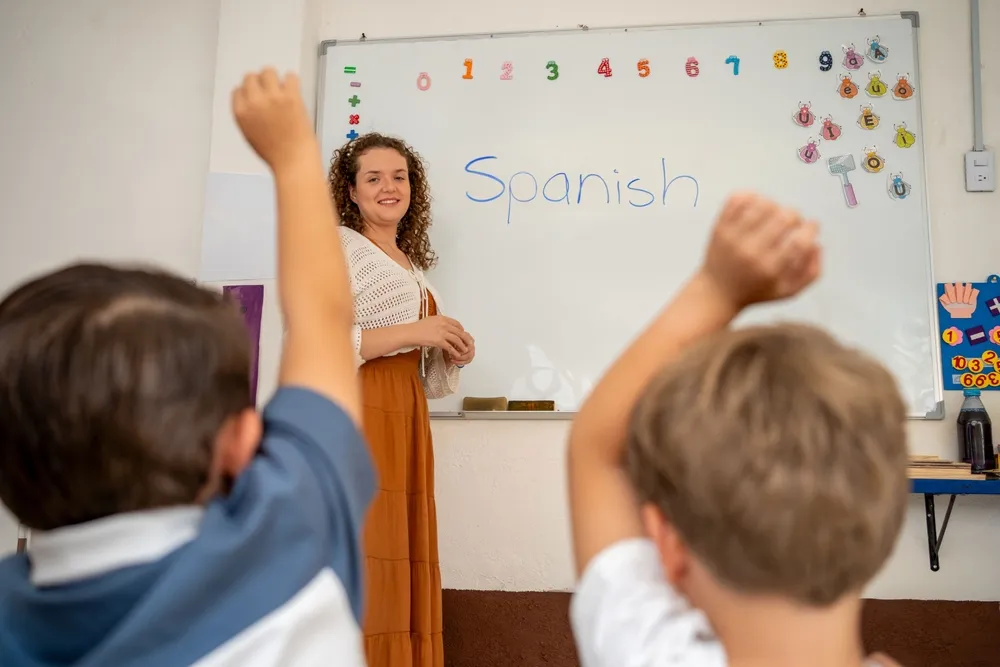
Spanish is spoken across many countries and communities, and it does not describe one single culture. Even within a city, families may differ in how they speak, what they celebrate, what they eat, and what stories they tell. A lesson that reduces “Spanish culture” to one costume, holiday, or food gives children a narrow picture.
A richer approach starts with a specific person, place, or story: a book by a Mexican American author, a song from Colombia, or a grandparent’s family tradition. Name where an example comes from without suggesting every Spanish-speaking household shares it.
The Irvine Public Library’s reading recommendations offer a local starting point: the library has highlighted books about Hispanic and Latino experiences for children and other readers. Reading a story together makes room for questions such as, “What matters to this family?” and “What is similar to or different from ours?” Those questions invite observation without asking children to make assumptions about a classmate.
Culture is present in ordinary life. The Library of Congress activity on family customs suggests inviting children to ask relatives about their traditions. That inquiry turns a language activity into a conversation about people.
Four ways Spanish learning connects with the SELF4Kids philosophy
SELF4Kids organizes its approach around Skills, Endurance, Leadership, and Flexibility. These are ways to think about a child’s experience with language, not claims that a particular activity produces a guaranteed developmental outcome.
Skills: Use words to communicate something real
A child can learn colors from flashcards, but a real task gives those words a job. Ask two children to sort art supplies, request a lápiz rojo, and thank a partner for passing it. They can point, repeat, and correct themselves while still completing the activity. The language becomes connected to listening, speaking, and cooperation.
Older children might make a bilingual sign for a pretend store or ask questions about a story. Invite Spanish-speaking children to contribute without making them responsible for teaching everyone else.
Endurance: Stay with an unfamiliar task
Children often want to say a new word perfectly on the first try. Learning another language offers a gentle chance to practice again after a mistake. An adult can model the word, give the child time to listen, and celebrate the effort to communicate. A funny mispronunciation need not become a public performance.
Progress may be gradual: recognizing a greeting, joining a song, then using the greeting independently. Encourage the habit, “I can try, listen, and try again.”
Leadership: Make space for someone else’s voice
Leadership in a group language activity can be as simple as inviting a quieter child to take a turn, asking a friend how to say a name correctly, or checking that everyone understands the rules of a game. Adults can praise the behavior they see: “You waited for your partner’s answer,” or “You asked before correcting them.”
In group projects, rotate roles so each child participates. Speaking confidently and listening carefully belong together.
Flexibility: Find another way to understand
When children lack a word, they can point, draw, gesture, ask for help, or try a simpler sentence. They can discover that a friend may describe the same object with a different word or pronunciation. Practicing those adjustments helps keep a conversation going.
That flexibility extends to culture. A child may learn that another family’s celebration looks different from the one shown in a book. An adult can respond, “Tell me about how your family does it,” rather than treating either version as the only correct one. SELF4Kids’ curriculum overview describes flexibility as open-mindedness and adapting to change; language and cultural activities offer concrete ways to discuss those ideas.
What does age-appropriate Spanish learning look like?
For younger school-age children, begin with movement, repetition, pictures, and a small number of useful words. A greeting circle, matching game, or short read-aloud can give them a reason to listen and respond. Keep activities short enough that children can succeed and return to them later. If a child wants to answer with a gesture before speaking, that can be a reasonable first step.
For children in later elementary grades, make the task more open-ended. They could compare stories, interview a willing family member, or write directions for a game. Let them ask how words are used and where cultural examples come from.
For both groups, use books and recordings from credible speakers and creators. Pronounce children’s names correctly. Some children are beginners; others use Spanish daily at home. Give each a way to participate without embarrassment.
The Institute of Education Sciences’ family activities show how adults can build language through stories, questions, wordplay, descriptions, and everyday experiences. Those resources were developed to support young English learners and their home languages; parents can draw on the activity ideas while keeping their own child’s language goals in view.
Five practical ways Irvine families can start this week
You do not need a large collection of materials. Choose one activity that fits your child’s interests and repeat it often enough for the words to become familiar.
1. Read one story and ask real questions. Borrow a bilingual or Spanish-language children’s book at Irvine Public Library. Read together in the language you can use comfortably, look at the illustrations, and ask, “What do you notice?” If the book represents a particular community, say so. Avoid turning every page into a vocabulary quiz. The library’s event page can help families find current storytimes and cultural activities; check the calendar for dates and age guidance.
2. Give three words a job. Use rojo (red), azul (blue), and verde (green) in a drawing game. Reuse the words next week and add por favor (please). Context helps a child remember them.
3. Let children lead a conversation. Invite your child to ask a willing Spanish-speaking relative or friend about a favorite childhood game or family tradition. Help prepare respectful questions first. If there is no Spanish speaker in the family, a book or recorded interview can still introduce a real person’s perspective. Children should learn that one person’s story belongs to that person, rather than standing in for millions of others.
4. Use music as a beginning, then talk. Listen to a song with a clear source. Identify a repeated word and ask what it might mean. If you explore a dance, craft, or recipe, learn where it comes from.
5. Notice language in the community. At a library, cultural event, or neighborhood gathering, ask your child what languages they heard or saw. Keep the conversation open: “What did you wonder?” rather than “Which person speaks Spanish?” People cannot be identified by appearance, and no one owes your family a language lesson. When a conversation is welcome, a kind greeting can be enough.
Families in Orange County can also consult the county’s public library services for books and events near them. Irvine residents can use the City of Irvine multicultural directory to explore additional local activities. Schedules and offerings change, so check the current listings before making plans.
What should parents look for in a children’s Spanish program?
Start by defining your goal. Do you want a relaxed introduction to Spanish? A weekly enrichment activity that connects language to stories and play? Sustained instruction intended to build reading and speaking proficiency? These are different experiences, and a provider should be able to explain which one it offers.
Ask how often children use Spanish, how instructors model pronunciation, and how activities change with age. Look for conversation alongside practice. Ask which communities appear in the materials; a thoughtful program names its sources and avoids stereotypes.
Also ask how progress is described. A beginner may first recognize words, participate in a song, or feel comfortable asking a simple question. Those signs deserve attention, but they are not the same as fluency. If your goal is biliteracy, ask for a clear plan for sustained speaking, reading, and writing. California’s Department of Education describes biliteracy pathways for younger learners and separate high school recognition; neither designation should be implied by a casual enrichment class.
Watch how adults respond when children hesitate. A supportive teacher gives time, models language without shaming, and respects a child’s home language.
How does SELF4Kids fit into this conversation?
SELF4Kids is an Irvine learning center whose afterschool program describes arts, music, dance, sports, and STEM projects alongside personalized guidance. Its S.E.L.F. curriculum emphasizes communication and collaboration, perseverance, leadership, and open-mindedness. These goals give parents a useful lens for thinking about any language or cultural learning opportunity their child joins.
SELF4Kids President and Owner Mahsheed Hosseini brings a focus on childhood development, leadership, coaching, goal-setting, and friendships to the center’s educational approach. For families exploring language and culture, that approach offers a practical starting point: give children chances to connect with people, ask questions, and keep trying.
SELF4Kids’ current program pages do not describe a dedicated Spanish course. Families who want Spanish instruction should
contact the center to ask what language or cultural activities, if any, are currently offered, how often they meet, and whether they fit their child’s age and goals. For families evaluating broader enrichment in Irvine, the afterschool page explains the existing program.
Frequently asked questions
Is Spanish useful for children who already speak English?
Yes. Spanish can give an English-speaking child another way to communicate and a reason to learn about different people’s experiences. Early exposure is a starting point; proficiency depends on sustained, meaningful practice.
Should a Spanish-speaking family stop using Spanish at home so a child learns English faster?
No. Families can continue speaking the language they use comfortably. Federal home-language guidance encourages maintaining and developing children’s home languages while they learn English. If your child needs individualized school support, talk with their teacher about their specific needs.
Will learning Spanish confuse my child?
Hearing or using more than one language can include mixing words and uneven progress across settings. That alone is not a reason to give up a family language. If you have a specific concern about speech, language, or learning, speak with an appropriate qualified professional and describe what you observe in all the languages your child uses.
Does SELF4Kids currently offer Spanish classes in Irvine?
The current SELF4Kids program pages reviewed for this article do not list a dedicated Spanish class.
Contact SELF4Kids for current offerings and schedules; the center’s afterschool program provides details about its published enrichment activities.
Start with a question, a story, and a conversation
Learning Spanish can be a way for an Irvine child to communicate more widely and appreciate the many families who shape the community. The strongest first steps are specific and personal: read a story from a real creator, learn a few useful words, listen to someone’s experience, and return to the activity next week. Keep expectations honest. A child may gain curiosity and confidence from exposure, while conversational ability takes much more sustained practice.
If you are looking for an Irvine afterschool environment that values communication, perseverance, leadership, and flexibility, explore SELF4Kids’ afterschool program. You can ask the team about current activities and choose the learning opportunities that fit your child’s interests and your family’s goals.
Frequently Asked Questions About Spanish Learning for Kids in Irvine
1. Why should kids in Irvine learn Spanish?
Spanish gives children another way to communicate and helps them learn about the communities that use the language. Stories, conversations, and cultural activities can make learning relevant to everyday life in Irvine. Children do not need to be fluent to benefit from a respectful introduction.
2. What is the best age for a child to start learning Spanish?
Children can start hearing and using Spanish at any age. Younger children may enjoy songs, picture books, and games; older children can ask questions, read stories, and practice conversations. Choose activities that suit your child’s interests and experience rather than waiting for a particular birthday.
3. Is it too late for a 7- to 12-year-old to learn Spanish?
No. School-age children can begin with useful phrases, stories, games, and conversations. They may also be ready to ask how words work and why customs vary across communities. Consistent opportunities to use the language matter more than having started as a toddler.
4. How long does it take a child to become fluent in Spanish?
There is no reliable deadline. Progress depends on how often a child hears and uses Spanish, the quality of instruction, opportunities to talk with others, and their learning goals. Understanding greetings may come quickly; confident speaking, reading, and writing take sustained practice.
5. Is one Spanish class a week enough for kids?
A weekly class can introduce vocabulary and keep a child interested, especially when the family also reads, listens, or plays in Spanish between sessions. It is unlikely to produce fluency by itself. Ask a program what children practice each week and how they can use Spanish beyond class.
6. Will learning Spanish confuse my child or cause a language delay?
Learning more than one language does not itself cause a developmental language disorder, according to the National Institute on Deafness and Other Communication Disorders. Children may use words from both languages as they learn. If you are concerned about persistent communication difficulties, discuss what you observe across all your child’s languages with a qualified professional. NIH
7. Should we stop speaking Spanish at home to help our child learn English?
No. Keep using the language your family speaks comfortably. Federal home-language guidance encourages families to maintain and develop children’s home languages while they learn English. If your child needs support at school, discuss their individual needs with their teacher. www.ncela.ed.gov
8. Can parents help a child learn Spanish if they do not speak it?
Yes. You can borrow a bilingual book, listen to a story with your child, or learn a few useful phrases together. Ask questions about the story and invite your child to explain what they noticed. Choose materials with clear sources and accurate pronunciation; you do not have to know every answer.
9. Where can families explore Spanish language and culture in Irvine for free?
Start with Irvine Public Library’s catalog and event calendar for books, storytimes, and cultural activities. Offerings vary, so check current listings. At home, a borrowed story can lead to a conversation about its author, setting, and the particular community it portrays. cityofirvine.gov
10. Does SELF4Kids currently offer Spanish classes in Irvine?
The current SELF4Kids program pages reviewed for this article do not list a dedicated Spanish class. Contact SELF4Kids for current offerings and schedules; the center’s afterschool program describes its published enrichment activities.