
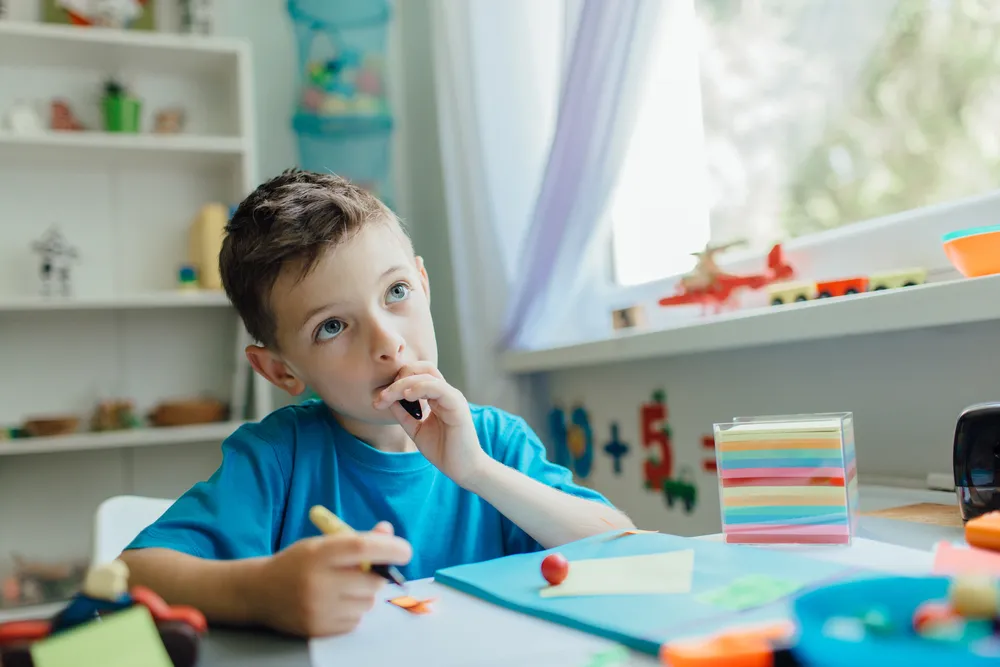
Modern childhood is changing rapidly. Children today navigate far more information, choices, and social complexity than previous generations. Memorizing facts is no longer enough. To thrive academically, socially, and emotionally, children need strong critical thinking skills, the ability to analyze, question, adapt, evaluate, and create solutions independently.
At SELF4Kids Learning Center, founder and Educational Director Mahshid Hosseini has spent more than fifteen years observing how children develop problem-solving abilities in real educational environments. Through thousands of interactions with children from preschool through elementary school, she developed the proprietary SELF4Kids Framework: Skills, Endurance, Leadership, and Flexibility a whole-child model designed to strengthen executive functioning, confidence, and lifelong learning habits.
Parents often ask: What should critical thinking actually look like at my child’s age? The answer varies significantly between ages 3 and 10. This guide provides developmental milestones, practical strategies, and real-world observations to help families support healthy cognitive growth.
Contents
- 1 Beyond Rote Memorization: Why Modern Problem-Solving Requires S.E.L.F.
- 2 The Early Years: Critical Thinking Milestones for Preschoolers (Ages 3-5)
- 3 The Transition Phase: Building Cognitive Flexibility in Early Elementary (Ages 6-7)
- 4 The Analytical Shift: Advanced Problem-Solving for Preteens (Ages 8-10)
- 5 The Socratic Blueprint: Mahshid Hosseini’s 3-Step Script for Parents
- 6 Recognizing Red Flags in Early Problem-Solving Development
- 7 Frequently Asked Questions
- 8 Conclusion: Nurturing Thinkers for Life
Beyond Rote Memorization: Why Modern Problem-Solving Requires S.E.L.F.
Answer Capsule: Critical thinking develops when children are encouraged to explore, experiment, and adapt, not simply follow instructions. Through the SELF4Kids framework, children strengthen executive function by building Skills, Endurance, Leadership, and Flexibility, allowing them to become confident, independent thinkers capable of solving unfamiliar problems.
Traditional instruction often rewards children for producing the “correct” answer as quickly as possible. While foundational knowledge matters, modern learning demands far more. Children must evaluate information, tolerate uncertainty, consider alternatives, and adapt when initial ideas fail.
Mahshid Hosseini frequently observes that children who receive constant adult direction often struggle when presented with open-ended challenges. They may immediately ask, “What am I supposed to do?” rather than experimenting independently.
By contrast, children who are regularly invited to create, design, build, negotiate, and explore tend to develop stronger executive functioning skills.
At SELF4Kids, educators intentionally avoid over-directing children. Instead of providing rigid step-by-step instructions for every activity, children are often asked:
- “How would you solve this?”
- “Can you think of another way?”
- “What happens if we try something different?”
- “Why do you think that happened?”
This approach aligns with the four pillars of the SELF4Kids framework:
Skills
Children build cognitive tools such as observation, reasoning, planning, communication, and analysis.
Endurance
Children learn to persist through challenges, tolerate frustration, and continue working even when solutions are not immediate.
Leadership
Children practice collaboration, conflict resolution, decision-making, and responsible influence within peer groups.
Flexibility
Children strengthen cognitive flexibility by adjusting strategies, accepting new perspectives, and adapting to unexpected outcomes.
Together, these pillars form the foundation for executive functions including working memory, inhibitory control, self-regulation, planning, and organization—all essential components of strong critical thinking.

The Early Years: Critical Thinking Milestones for Preschoolers (Ages 3-5)
Answer Capsule: Between ages 3 and 5, critical thinking emerges through curiosity, cause-and-effect exploration, categorization, and endless “why” questions. These early experiences build the executive function foundation children later use for reasoning, decision-making, and independent problem-solving.
Preschoolers are natural scientists.
The famous “Why?” phase is not merely a developmental inconvenience; it is one of the earliest and most important engines of logical thinking. Young children ask repeated questions because they are actively building mental models about how the world works.
Children from ages 3 to 5 begin recognizing patterns, identifying relationships, predicting outcomes, and understanding simple sequences.
For example, a child who says, “If I water the plant, it grows,” is demonstrating early cause-and-effect reasoning.
Likewise, when children sort objects by color, shape, or size, they are practicing categorization, a foundational cognitive skill required for later mathematics, science, and reading comprehension.
Preschool Critical Thinking Checklist (Ages 3-5)
- Asks frequent “why,” “how,” and “what if” questions.
- Sorts objects into categories.
- Recognizes simple patterns.
- Predicts basic outcomes during play.
- Understands simple cause-and-effect relationships.
- Experiments through trial and error.
- Uses pretend play to explore different scenarios.
- Begins solving simple social conflicts with support.
- Identifies similarities and differences between objects.
- Suggests multiple uses for familiar items.
The Play-Based Approach: Why Guided Play Outperforms Forced Academics
Research and classroom experience consistently demonstrate that guided play produces stronger long-term cognitive outcomes than early academic drilling.
At SELF4Kids, educators regularly observe that children learn powerful problem-solving skills during peer interactions.
A disagreement over building blocks, for example, becomes an opportunity to negotiate, compromise, test ideas, and revise plans.
During imaginative play, children naturally practice:
- Perspective-taking.
- Planning.
- Sequencing.
- Rule creation.
- Flexible thinking.
- Emotional regulation.
Rather than asking, “What is the correct answer?” educators ask, “How else could we do this?”
This subtle shift transforms play into a laboratory for how to teach critical thinking to kids.

The Transition Phase: Building Cognitive Flexibility in Early Elementary (Ages 6-7)
Answer Capsule: Children ages 6 to 7 begin moving beyond emotional impulsivity. They increasingly evaluate choices, anticipate consequences, recover from mistakes, and adjust strategies when initial solutions fail, making cognitive flexibility and frustration tolerance essential developmental goals.
The transition into elementary school represents a significant cognitive leap.
Children begin managing more structured expectations while simultaneously developing independence.
One of the most important capacities during this stage is cognitive flexibility in early elementary settings.
Cognitive flexibility allows children to shift approaches when their first idea does not work.
A child who repeatedly insists on one strategy despite repeated failure may require additional support developing this skill.
Equally important is Endurance.
Many children initially interpret mistakes as evidence of inability. At SELF4Kids, educators intentionally normalize struggle by emphasizing process rather than perfection.
Statements such as:
“Your strategy didn’t work yet. What could we try next?”
encourage persistence and resilience.
Critical Thinking Checklist (Ages 6-7)
- Consider more than one possible solution.
- Revises strategies after setbacks.
- Explains reasoning using simple evidence.
- Predicts likely consequences of choices.
- Demonstrates increased frustration tolerance.
- Follows multi-step problem-solving tasks.
- Begins evaluating fairness and rules.
- Resolves simple peer conflicts with reduced adult support.
- Distinguishes facts from opinions in familiar contexts.
- Reflects on mistakes and attempts corrections.
Storybooks as Scaffolding: A Practical Parent Strategy
Children’s literature provides one of the most powerful tools for teaching Socratic questioning for children.
After reading together, avoid asking only factual questions.
Instead, ask:
- Why do you think the character made that choice?
- What else could the character have done?
- What would you do differently?
- How might another character view this situation?
- What evidence supports your idea?
These conversations strengthen perspective-taking, empathy, inferential reasoning, and alternative hypothesis generation.
Books become cognitive rehearsal spaces where children safely practice complex reasoning.

The Analytical Shift: Advanced Problem-Solving for Preteens (Ages 8-10)
Answer Capsule: Between ages 8 and 10, children demonstrate more advanced critical thinking through metacognition, media evaluation, perspective-taking, collaboration, and evidence-based reasoning. They increasingly learn to think about their own thinking while navigating complex social and digital environments.
By ages 8 to 10, children become capable of significantly more sophisticated reasoning.
They begin asking not only, “What happened?” but also, “How do I know this is true?”
This developmental stage is particularly important because children are increasingly exposed to digital information.
Media literacy therefore becomes an essential aspect of critical thinking.
Children should learn to ask:
- Who created this information?
- Why was it created?
- Is there evidence?
- Could another explanation exist?
- Is this fact, opinion, advertising, or entertainment?
Metacognition—thinking about one’s own thinking—also expands dramatically.
Children begin recognizing:
- “I rushed and made a mistake.”
- “I need more information.”
- “I learn better when I draw diagrams.”
Leadership emerges in increasingly visible ways.
At SELF4Kids, older children frequently collaborate on projects requiring negotiation, delegation, compromise, and collective decision-making.
Real leadership is not simply directing others. It involves listening, integrating perspectives, and guiding shared problem-solving.
Critical Thinking Checklist (Ages 8-10)
- Evaluates evidence before reaching conclusions.
- Identifies multiple perspectives in conflicts.
- Detects simple forms of bias.
- Distinguishes fact, opinion, and persuasion.
- Reflects on personal learning strategies.
- Plans long-term projects independently.
- Collaborates effectively with peers.
- Negotiates disagreements constructively.
- Monitors and adjusts thinking processes.
- Questions information encountered online.
These represent important problem-solving milestones by age during the preteen years.
The Socratic Blueprint: Mahshid Hosseini’s 3-Step Script for Parents
Answer Capsule: The Socratic method helps children become active thinkers rather than passive answer-receivers. By validating questions, exploring prior knowledge, and encouraging alternative explanations, parents strengthen independence, reasoning, and lifelong problem-solving habits.
When children encounter challenges, adults often rush to provide answers.
Yet immediate solutions frequently rob children of valuable cognitive practice.
Instead, Mahshid Hosseini recommends the following three-step approach.
Step 1: Pause and Validate the Question
Begin by acknowledging the child’s curiosity or struggle.
Examples:
- “That’s an interesting question.”
- “I can see you’re working hard on this.”
- “I’m glad you asked.”
Validation communicates that thinking itself has value.
Step 2: Probe Existing Knowledge Using Open Questions
Before answering, explore what the child already knows.
Ask:
- What do you already think?
- What have you noticed so far?
- What clues do you have?
- What happened the last time?
Children frequently possess more understanding than adults realize.
Step 3: Encourage Alternative Hypotheses
Invite children to generate possibilities.
Ask:
- Can you think of another explanation?
- What else might happen?
- Is there a different way to solve this?
- What could we try next?
The goal is not perfect accuracy. The goal is flexible reasoning.
Classroom Example from SELF4Kids: During a bridge-building challenge, one child became frustrated when the structure repeatedly collapsed. Instead of fixing it, the educator asked, “What do you notice about where it keeps falling?” The child observed that one side lacked support and independently redesigned the base. Moments like these illustrate how guided questioning transforms frustration into authentic problem-solving growth.
Recognizing Red Flags in Early Problem-Solving Development
Answer Capsule: Children may struggle with independent logic when they consistently avoid challenges, rely completely on adult direction, show extreme distress during trial-and-error tasks, or demonstrate significant difficulty adapting when plans change. Early support can strengthen confidence and executive functioning.
Every child develops at an individual pace. However, persistent patterns may warrant closer observation.
Potential warning signs include:
- Absolute dependence on adult instructions for familiar tasks.
- Extreme frustration during minor challenges.
- Refusal to attempt new solutions.
- Frequent statements such as “I can’t” before trying.
- Difficulty adapting when routines change.
- Inability to recover after small mistakes.
- Avoidance of open-ended activities.
- Significant difficulty considering others’ perspectives.
- Excessive fear of making mistakes.
- Persistent rigidity during peer interactions.
These behaviors do not automatically indicate developmental concerns. They may simply signal that a child needs additional opportunities to practice flexibility, persistence, and independent reasoning.
Nurturing a Safe Space for Mistakes
One of the strongest predictors of healthy critical thinking is psychological safety.
Children think more deeply when they believe mistakes are accepted as part of learning.
In the SELF4Kids environment, educators intentionally celebrate revision, experimentation, and productive struggle.
When adults respond to mistakes with criticism, children often become risk-averse.
When adults respond with curiosity, “What did we learn?”, children become thinkers.
Creating a safe environment means praising effort, modeling mistakes openly, and demonstrating that unsuccessful attempts are valuable information rather than failure.
Frequently Asked Questions
1. What is critical thinking in children?
Critical thinking in children is the ability to analyze information, ask questions, solve problems, and make decisions independently rather than simply memorizing answers.
2. At what age do children start developing critical thinking skills?
Children begin developing early critical thinking skills around age 3 through play, cause-and-effect exploration, asking questions, and experimenting with different solutions.
3. How can parents teach critical thinking at home?
Parents can teach critical thinking by asking open-ended questions, encouraging children to explain their reasoning, and allowing them to solve problems independently before offering help.
4. What are examples of problem-solving milestones by age?
Preschoolers sort and categorize objects, children ages 6 to 7 evaluate choices and adapt strategies, while children ages 8 to 10 analyze evidence and consider multiple perspectives.
5. Why is cognitive flexibility important for kids?
Cognitive flexibility helps children adjust when plans change, recover from mistakes, and explore alternative solutions, which are essential skills for academic and social success.
Conclusion: Nurturing Thinkers for Life
Critical thinking is not a single skill that children suddenly acquire, it is a developmental journey built through curiosity, experimentation, reflection, and resilience. From the endless “why” questions of preschoolers to the analytical reasoning of preteens, every stage offers valuable opportunities to strengthen problem-solving abilities and executive function.
At SELF4Kids, we believe that children become confident thinkers when they are encouraged to ask questions, explore multiple solutions, make mistakes, and try again. Through the SELF4Kids Framework, Skills, Endurance, Leadership, and Flexibility, we help children develop the cognitive tools they need not only to succeed academically, but to thrive in an ever-changing world.
If you would like to support your child’s critical thinking development through hands-on learning, personalized coaching, and a nurturing educational environment, we invite you to discover the SELF4Kids difference. Contact SELF4Kids today to learn more about our enrichment programs, private learning opportunities, and whole-child approach designed to help every child become an independent, creative, and resilient problem-solver.